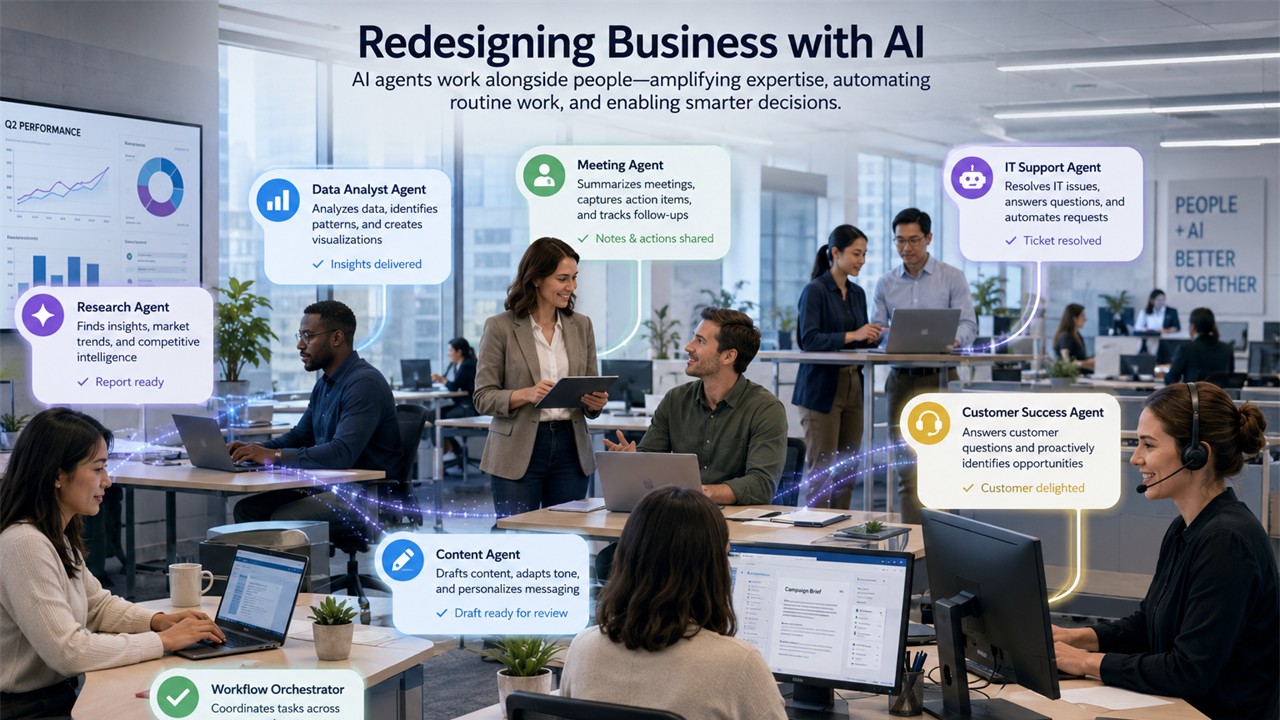
AI Isn’t Just Changing Jobs. It’s Redesigning Business.
A recent CNN article discussing whether AI is “taking jobs” sparked an important conversation around the future of work. But the bigger issue for business leaders may not be job replacement at all it’s how AI is fundamentally redesigning how organisations operate.
For years, digital transformation in Australia largely meant moving to the cloud, modernising ERP systems, improving reporting, and automating workflows.
That era is ending.
The next phase of transformation is not simply about technology upgrades. It’s about redesigning how organisations operate when AI becomes embedded into everyday work.
Recent discussions around AI “taking jobs” miss the bigger picture. In reality, AI is more likely to automate tasks than entire professions. The repetitive work that sits inside many roles — reporting, summarising, data analysis, coordination, documentation, and administration — is now increasingly being handled by AI-driven systems.
For business leaders, this creates both opportunity and urgency.
The organisations that move fastest won’t necessarily be the ones with the biggest AI budgets. They’ll be the ones willing to rethink operating models, decision-making processes, and workforce design.
In many Australian businesses, the real challenge isn’t access to AI tools like ChatGPT or Microsoft Copilot. It’s the underlying environment they operate in. Fragmented systems, spreadsheet-heavy processes, poor data quality, and disconnected workflows can quickly limit the value AI delivers.
AI amplifies whatever environment already exists.
If your organisation has strong governance, connected data, and streamlined processes, AI can accelerate productivity and insight dramatically. If not, it can scale inefficiency just as quickly.
This is why CFOs, COOs, and CIOs are increasingly central to AI strategy discussions. AI transformation is no longer purely an IT initiative. It directly impacts productivity, workforce structure, operating margins, forecasting accuracy, customer experience, and risk management.
The most successful organisations over the next five years will likely combine human expertise with AI-enabled workflows rather than treating AI as a standalone technology project.
The real competitive advantage may not come from AI replacing people.
It may come from organisations where people using AI outperform those who don’t.
The question Australian business leaders should now be asking is not:
“Should we adopt AI?”
But rather:
“What should our business look like when AI becomes part of every workflow?”


