
As traditional budgeting methods fall short, modern CFOs are pivoting towards advanced tools and technologies to stay competitive in a volatile and unpredictable landscape.
In this article, we’ll explore the role of AI in budgeting and forecasting. Discover how AI tools equip financial planning & analysis (FP&A) teams with the critical insights needed to guide their companies through challenging times and maintain a competitive edge.
What is AI in financial forecasting and budgeting?
Artificial intelligence (AI) in finance refers to the use of AI technologies to enhance and automate traditional financial tasks. AI revolutionizes financial operations by automating repetitive processes and providing real-time recommendations—thus improving how businesses analyze, manage, and invest capital.
AI for finance professionals and CFOs delivers substantial business value by streamlining processes and shifting the focus from data collection to strategic oversight.
AI, including natural language processing (NLP) and machine learning (ML), are key elements driving the success of autonomous finance.
Here are key examples of AI applications in finance:
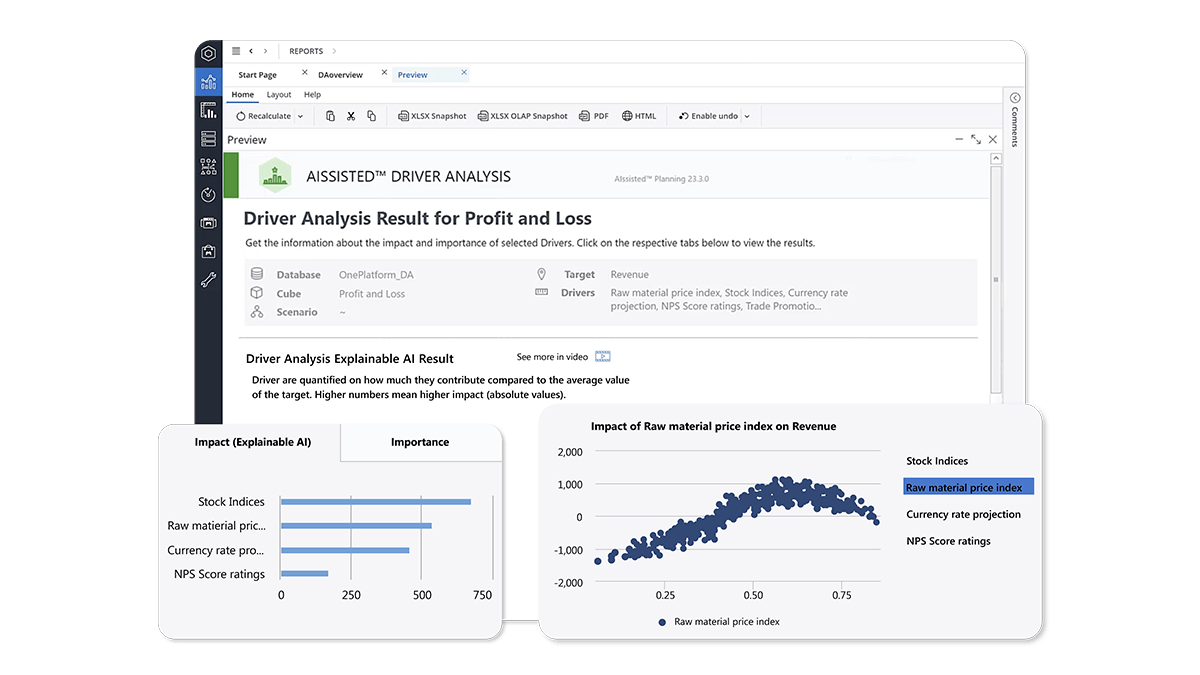
AI in financial forecasting: Used to predict future financial results by analysing past data based on key drivers determined by the Finance team. AI-enabled forecasting learns and adapts, enhancing accuracy as more data is analysed. This is particularly valuable in the rapidly changing finance industry.
Advanced reporting with NLP: AI redefines financial reporting by acting as an extension of your FP&A team. It uses natural language to collect data, generate reports, analyze trends, optimize forecasts, and answer complex business questions. It can be tailored to your unique business needs and becomes smarter over time as it learns more about your organization.
ML for identifying financial trends: About 70% of financial companies use ML to improve their ability to predict and analyze data. ML, a branch of AI, relies on data and self-modifying methods to identify patterns and make predictions. It continuously refines itself for improved future outcomes. This aids in assessing and managing financial risk by predicting potential losses and identifying risk factors, allowing institutions to take proactive measures.
The benefits of AI in financial forecasting
In an era characterised by rapid change and unpredictability, the ability to forecast accurately and efficiently has never been more critical for businesses. AI in financial forecasting provides tools and methods that enhance precision, speed, and strategic planning. Below are several significant advantages that AI offers:
Improved accuracy
The introduction of AI in financial forecasting has set a new standard for accuracy by significantly reducing errors through the use of real-time data, pattern recognition, and trend predictions.
IBM research indicates that half of the businesses employing AI in budgeting and forecasting have managed to cut their overall error by at least 20%. Additionally, 25% of these companies achieved a reduction of at least 50%.
Speed and efficiency
The pace at which AI processes information grants Finance teams the ability to make swift decisions. AI’s capability to handle large datasets and identify complex patterns at speeds unmatched by human analysts saves significant time and resources.
By rapidly pinpointing anomalies and predicting future outcomes, AI not only accelerates the forecasting process but also enhances the quality of insights delivered to decision-makers. This enables them to act with greater confidence and agility.
What if scenario planning with AI
Traditional scenario planning, often sidelined due to its resource-intensive nature, is undergoing a transformation with AI. AI-driven scenario planning allows finance professionals to explore multiple potential futures, assessing a range of outcomes from best-case to worst-case scenarios.
AI in budgeting and forecasting enables a more collaborative approach to scenario planning. By integrating data across sales, operations, finance, HR, and other business units, AI tools facilitate the creation of comprehensive scenarios that reflect the diverse realities of each department.
This inclusivity ensures a holistic view of potential trajectories, empowering businesses to stress test their strategies and monitor key indicators for various outcomes.

 Artificial Intelligence for Life